 Ultimate guide
The Homeowner's Weekly Pool Maintenance Checklist
Last Updated: November 14, 2026
Quick Summary
A weekly pool maintenance checklist is a fixed set of cleaning, testing, and inspection tasks done in the same order every week. Skim the surface, empty the skimmer and pump baskets, brush walls and tile, vacuum the floor, test the water, balance and sanitize, then check water level, filter pressure, and circulation. Most homeowners spend 45 to 60 minutes on the full routine.
- Skim and empty baskets before vacuuming, and test water before adding any chemicals.
- Test free chlorine, pH, total alkalinity, and stabilizer weekly, and record the numbers.
- Clean or backwash the filter when the pressure gauge climbs roughly 8 to 10 PSI above its clean baseline.
- In a heat wave, test free chlorine daily rather than weekly and extend pump run time.
- Shock when combined chlorine is high, after heavy use, or after a storm, not every week.
Table of Contents
- Why a Weekly Pool Maintenance Checklist Saves You Money
- Your Printable Weekly Pool Maintenance Checklist for Homeowners
- Pool Maintenance for Beginners: Tools, Time, and What to Skip
- How to Build a Pool Maintenance Checklist Template That Fits Your Pool
- Chlorine, Saltwater, and Other Systems: Adjusting the Routine
- Troubleshooting Cloudy Water, Algae, and Odd Filter Pressure
- What a Weekly Pool Service Checklist Should Include When You Hire Help
- Requesting a Quote from Clear Water Pools
- Frequently Asked Questions
Why a Weekly Pool Maintenance Checklist Saves You Money
A weekly pool maintenance checklist for homeowners is a fixed set of cleaning, testing, and inspection tasks completed in the same order every week.
Small problems caught weekly stay small. Missed for a month, a pH drift turns into scale and a sanitizer crash turns into a green pool.
Below, we'll show you exactly how to run the routine yourself, what to test for, and when to hand it off.
Your Printable Weekly Pool Maintenance Checklist for Homeowners
Here is a printable weekly pool maintenance checklist for homeowners. Print it, tape it inside the pump shed, and check the boxes in order: skim and empty baskets before you vacuum, and test water before you add anything.
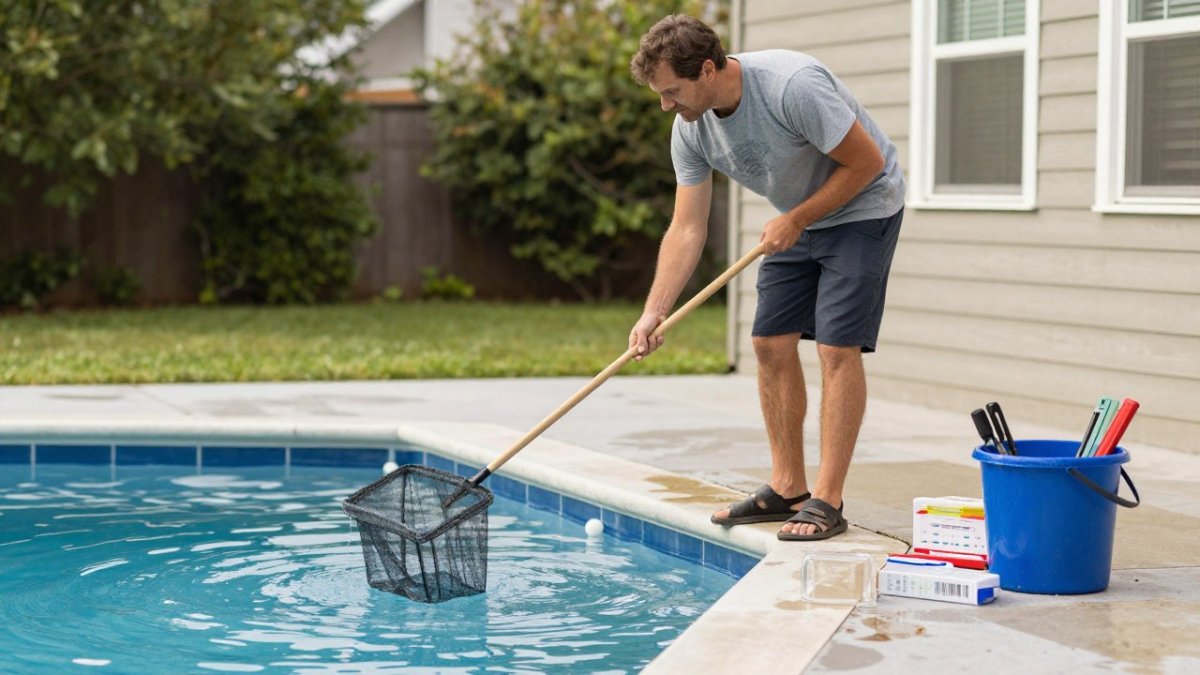
The Seven Weekly Tasks in Order
- Skim the surface. Net leaves, insects, and debris before they sink. Five to ten minutes on a typical residential pool. Work from the shallow end toward the skimmer so the net pushes floating debris into the flow.
- Empty the skimmer and pump baskets. Hair and leaf litter restrict flow and strain the pump. Clear both every visit. On a saltwater pool, rinse the pump basket of salt residue before reinstalling it.
- Brush walls, steps, and the waterline tile. Algae clings to surfaces before it clouds the water. Brush toward the main drain. Pay extra attention to the waterline tile, steps, and any shaded corner where circulation is weak.
| Task | Time | Frequency |
|---|---|---|
| Skim surface | 5-10 min | Weekly |
| Empty baskets | 3-5 min | Weekly |
| Brush walls and tile | 10-15 min | Weekly |
| Vacuum floor | 15-20 min | Weekly |
| Test and balance water | 10 min | Weekly |
| Check filter and water level | 5 min | Weekly |
Time
Most homeowners spend 45 to 60 minutes on the full routine.
Test Targets and Correction Steps
Testing is only useful if you know what the numbers should be and what to do when they are off.
| Reading | Target range | If low | If high |
|---|---|---|---|
| Free chlorine | 2-4 ppm | Add sanitizer; check stabilizer | Let sunlight burn off; do not add more |
| pH | 7.4-7.6 | Raise with pH increaser | Lower with acid per label |
| Total alkalinity | 80-120 ppm | Raise with alkalinity increaser | Lower with acid and aeration |
| Cyanuric acid (stabilizer) | 30-50 ppm | Add stabilizer | Partial drain and refill |
| Salt (saltwater pools) | Per cell manufacturer, commonly 2,700-3,400 ppm | Add pool salt | Partial drain and refill |
When a reading is off, adjust one thing at a time and retest before adding more. Correct alkalinity before chasing pH, since alkalinity stabilizes pH. If stabilizer is too high, a partial drain and refill is the only reliable fix.
Pool-Type Variations
- Chlorine pool: add liquid or granular sanitizer after testing and let the pump run to distribute it. Do not broadcast granular chlorine into the skimmer.
- Saltwater pool: the salt cell generates chlorine, so you check cell output and salt level instead of pouring liquid chlorine. Inspect the cell for calcium scale monthly, and clean it only when scale is visible.
- Ozone or UV system: treat the secondary system as a supplement, not a replacement for a residual sanitizer. Keep testing free chlorine weekly.
Weather and Heavy-Use Adjustments
- Heat wave: test free chlorine daily rather than weekly, because sunlight and heat consume sanitizer faster. Extend pump run time so the filter turns the full volume over more often.
- Heavy use (party, rental turnover): test and shock after the guests leave, not before. Check combined chlorine and shock when it is elevated.
- Storm: skim and empty baskets immediately after the storm, then test and rebalance. Debris and runoff load the filter and shift chemistry.
Pool Maintenance for Beginners: Tools, Time, and What to Skip
What can you skip? Don't backwash or clean the filter on a fixed schedule. Clean it when the pressure gauge climbs roughly 8 to 10 PSI above its clean baseline.
A common mistake is trusting a cheap test strip for everything. Strips are fine for a quick chlorine and pH read, but a liquid or digital kit gives you the accuracy that matters when adjusting chemistry.
Testing Targets and What to Do When Readings Are Off
- Free chlorine low: add sanitizer, then check stabilizer. Low cyanuric acid lets sunlight burn off chlorine.
- pH high: add acid per label directions. High pH dulls chlorine and scales the cell.
- pH low: raise with a pH increaser. Low pH corrodes metal and etches plaster.
If your readings are drifting and you want the full testing method, our guide on how to verify pool water chemistry walks through it step by step.
How to Build a Pool Maintenance Checklist Template That Fits Your Pool
A pool maintenance checklist template should match your pool, not a generic form. Start with the seven tasks above, then add rows for anything specific to your setup: a spa spillover, a salt cell, a deck jet, a robot cleaner.
Build it in a spreadsheet with four columns: task, target, reading, and date. A sample row looks like this:
| Task | Target | Reading | Date |
|---|---|---|---|
| Free chlorine | 2-4 ppm | 3.0 ppm | 11/14 |
| pH | 7.4-7.6 | 7.5 | 11/14 |
| Filter pressure | Baseline +8 PSI | 14 PSI | 11/14 |
The target ranges above reflect widely published industry guidance from the Pool & Hot Tub Alliance and the Centers for Disease Control and Prevention's pool operator guidance.
Chlorine, Saltwater, and Other Systems: Adjusting the Routine
A chlorine pool and a saltwater pool share the same checklist, but the sanitizer step differs.
For a chlorine pool, add sanitizer after testing and let the pump run to distribute it.
One adjustment beginners routinely miss is run time. In hot weather and heavy-use weeks, extend pump run time so the filter turns the full volume over more often.
Troubleshooting Cloudy Water, Algae, and Odd Filter Pressure
Cloudy water, green water, and a climbing pressure gauge are the three symptoms that send most homeowners looking for help. Each points to a different cause, and each has a fix you can start this week.
Cloudy Water
Cloudy water is usually a filtration or chemistry problem, not a single-cause event. Check in this order:
- Filter pressure. If the gauge is roughly 8 to 10 PSI above its clean baseline, clean or backwash the filter first. A clogged filter cannot polish water no matter what chemistry you add.
- Free chlorine. If chlorine is not holding, check stabilizer. Low cyanuric acid lets sunlight burn off chlorine.
- Combined chlorine. If combined chlorine is elevated, shock the pool and run the filter continuously until the water clears.
- Circulation. Confirm the pump is moving water and the returns are pushing flow. A weak return or a stuck valve can leave a dead zone that stays cloudy.
Our guide on how to clear cloudy pool water quickly covers the full sequence.
Green Water
Green water is algae. Brush first, then shock, then run the filter continuously until clear. Brushing matters because algae protects itself on surfaces; adding algaecide before brushing does almost nothing. After the water clears, check stabilizer and chlorine demand, because an algae bloom often follows a period of low chlorine. Our article on why pool water turns green explains the causes.
High Filter Pressure
High filter pressure means restricted flow. Work through the checks in order:
- Baskets. Empty the skimmer and pump baskets first; a full basket is the most common cause.
- Filter media. Clean or backwash the filter when the gauge is roughly 8 to 10 PSI above baseline.
- Gauge. If pressure stays high after cleaning, the gauge itself may be failing. Compare it against a known-good gauge before replacing media.
Low Filter Pressure
Low pressure is the opposite problem and often points to a suction-side air leak or a pump issue. Check the pump basket O-ring, the union fittings, and the water level at the skimmer. If the pump is running but pressure is low and returns are weak, stop and inspect before running it further.
What a Weekly Pool Service Checklist Should Include When You Hire Help
A weekly pool service checklist should be documented, not verbal. When you hire help, ask what gets done each visit and how it's recorded.
Digital reports with photos and water readings are the difference between "trust us" and "here's the proof." Without a record of each visit, it can be hard to verify the work. Our article on signs a pool technician is skipping steps lists the warning signs.
Requesting a Quote from Clear Water Pools
Running this checklist yourself is entirely doable. Keeping it consistent through summer heat, storm season, and heavy guest use is where many homeowners fall behind.
Clear Water Pools provides weekly pool cleaning and equipment repair for residential homeowners, property managers, and commercial facilities throughout Central Florida.
Pricing depends on your pool size, equipment, and frequency, so please visit the Clear Water Pools website for current prices or to request a quote. You can see what the service covers and request a weekly pool cleaning quote when you're ready to hand off the checklist.
The hardest part of pool care isn't learning the tasks. It's doing them every week without fail, especially when life gets busy.
Frequently Asked Questions
What should a weekly pool service include?
A complete weekly visit covers surface skimming and debris removal, emptying the skimmer and pump baskets, brushing walls, steps, and the waterline tile, vacuuming the floor, testing and balancing water chemistry, checking the water level, and inspecting the filter and circulation system. Ask for written documentation of each visit, including water readings, so you can confirm the work was actually done.
What chemicals do I need to put in my pool every week?
Most pools need sanitizer (chlorine or salt-generated chlorine) maintained at the correct level, pH adjusted into the 7.4 to 7.6 range, and total alkalinity kept in check. Shock and algaecide are not automatic weekly additions; use them after heavy pool use, storms, or when water clarity drops. Always test first and add only what the readings call for, following label directions and storing chemicals safely away from children and pets.
How long should weekly pool maintenance take?
A routine weekly session typically runs 30 to 60 minutes for an average residential pool. Skimming, basket cleaning, and a quick equipment check take about 15 minutes; brushing and vacuuming take another 15 to 25; water testing and chemical adjustment add 10 to 15. Larger pools, heavy debris after storms, or neglected water can push the time higher.
What are the Three C's of pool maintenance?
The Three C's are circulation, cleaning, and chemistry. Circulation means running the pump long enough and keeping baskets and filters clear so water moves through the system. Cleaning covers skimming, brushing, and vacuuming. Chemistry means testing and balancing pH, sanitizer, and alkalinity. Miss any one of the three and the other two suffer, which is why a weekly pool maintenance checklist addresses all of them every visit.
How often should I test my pool water?
Test pH and chlorine two to three times per week during swimming season, and run a fuller panel for alkalinity and stabilizer weekly. After heavy pool use, high temperatures, or inclement weather, test before swimmers return. Keep a log of readings so you can spot trends, such as chlorine demand creeping up, before they turn into cloudy water or algae.
Can I use a printable checklist to keep track of pool maintenance?
Yes, and it helps. A printable weekly pool maintenance checklist for homeowners keeps task order consistent, gives you a place to record water readings, and makes it obvious when a step was skipped. Print a fresh copy each week, check off tasks as you go, and note anything unusual, like rising filter pressure or debris you cannot identify, for follow-up.