 How-to
How to Verify Pool Water Chemistry: A Step-by-Step Testing Guide
Last Updated: November 7, 2026
Quick Summary
To verify pool water chemistry, collect a sample at elbow depth away from jets and skimmers, then test free chlorine, pH, total alkalinity, calcium hardness, and cyanuric acid against their ideal ranges. Fix total alkalinity first, then pH, hardness, stabilizer, and free chlorine last, retesting after the pump runs a full turnover.
- Collect samples at elbow depth, about 45 centimeters down, away from jets and skimmers.
- Liquid drop kits take 2-5 minutes and read more accurately than test strips.
- Ideal free chlorine is 1-3 ppm and pH is 7.4-7.6.
- Fix total alkalinity before pH, since alkalinity buffers pH.
- Retest only after the pump runs at least one full turnover, typically several hours.
Table of Contents
- Why Verifying Pool Water Chemistry Matters
- How to Collect a Representative Water Sample
- How to Test Pool Water with Kit: Strips vs. Liquid Kits
- How to Test Pool Chemicals with Drops: A Step-by-Step Protocol
- Reading Your Results with a Pool Water Testing Chart
- How Often to Test Pool Water and When to Retest
- Troubleshooting Inaccurate Readings and Handling Chemicals Safely
- Request a Quote for Documented Weekly Water Testing
- Frequently Asked Questions
Why Verifying Pool Water Chemistry Matters
Learning how to verify pool water chemistry is the difference between guessing and knowing. Water that looks clear can still be corrosive, scaling, or unsafe, so verification matters. You cannot judge sanitizer levels by eye, and you cannot trust a reading you collected badly.
Pool water chemistry is the balance of sanitizer, pH, alkalinity, hardness, and stabilizer that keeps water safe and equipment healthy. Get it wrong and problems compound fast:
- Low chlorine lets algae and bacteria take hold within days
- Low pH eats at pump seals, heaters, and plaster
- High pH cuts sanitizer efficiency and clouds the water
- High calcium leaves scale on tiles and in the filter
The CDC guidance on healthy swimming and pool water is blunt about it: proper disinfectant levels and pH are the two controls that stop most waterborne illness. Verification is how you confirm both.
How to Collect a Representative Water Sample
Most bad readings start before the test. A sample taken near the surface, near a return jet, or right after a rainstorm tells you almost nothing about the pool as a whole.
A consistent sampling method helps:
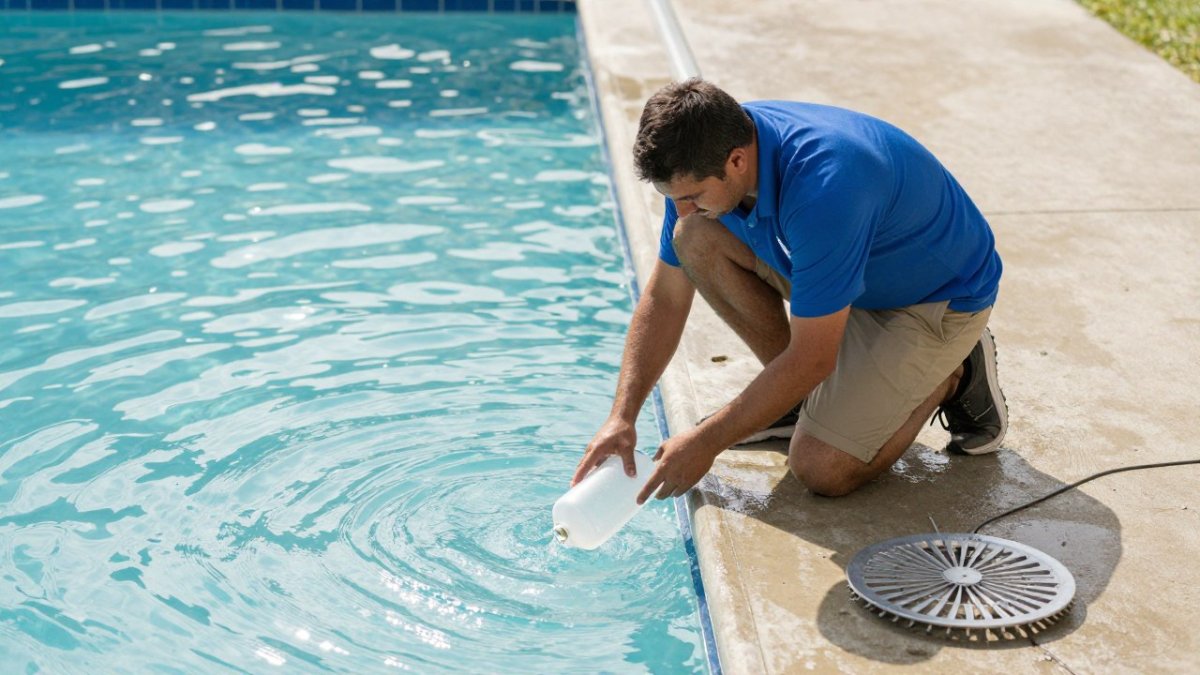
- Reach to elbow depth, about 45 centimeters down, away from jets and skimmers
- Turn the vial upside down, then right it underwater to trap water without surface film
- Collect at two or three spots around the pool and combine them
- Test within minutes, before the sample warms or sits
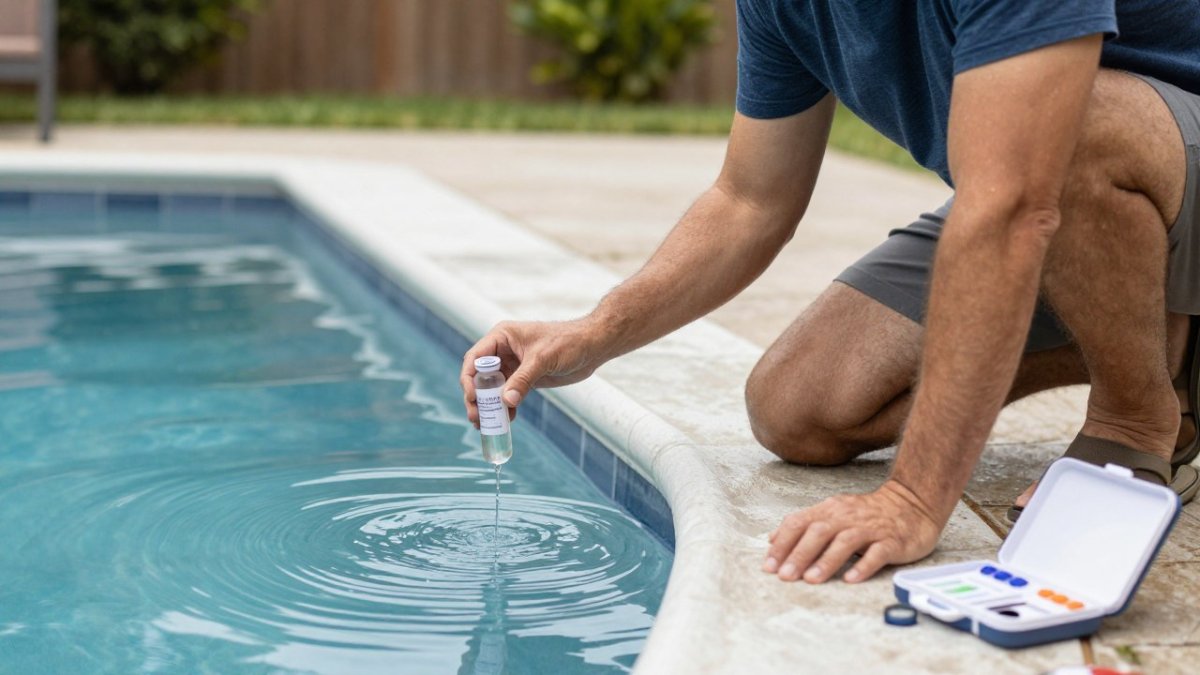
Watch out: testing water straight from a return jet reads artificially high on chlorine. That mistake sends people into unnecessary chemical adjustments.
How to Test Pool Water with Kit: Strips vs. Liquid Kits
Choosing how to test pool water with kit comes down to a trade-off between speed and precision. Strips are fast and cheap. Liquid kits cost more and take longer, but they read more accurately, especially at the edges of the ideal range.
| Method | Speed | Accuracy | Best For |
|---|---|---|---|
| Test strips | Seconds | Moderate | Quick daily checks |
| Liquid drops | 2-5 minutes | High | Weekly full testing |
| Digital tester | Seconds | High | pH and salt specifically |
Strips fade and absorb moisture, so keep the container sealed and check the expiration date. If a strip reading looks off, confirm it with drops before adding anything. For supplies and kits, you can browse pool chemicals and testing supplies with local guidance.
How to Test Pool Chemicals with Drops: A Step-by-Step Protocol
Liquid drop tests are a reliable way to take readings. Here is a protocol for testing pool chemicals with drops:
- Rinse the sample vial with pool water, then fill to the marked line
- Add the reagent drops exactly as the kit instructs, one at a time
- Cap and invert gently; do not shake hard
- Match the color against the chart in natural daylight, not shade
- Record the result before moving to the next test
- Repeat chlorine last if you tested it first, since it fades fastest
Run free chlorine first, then pH, then total alkalinity, then calcium hardness, then cyanuric acid. Clean the vial between tests with fresh water. Cross-contamination between reagents is a common cause of readings that make no sense.
Reading Your Results with a Pool Water Testing Chart
A pool water testing chart turns numbers into decisions, but the chart is only half the job. The other half is knowing which reading to act on first, how long to wait, and when a second test is meaningful. Compare each result to its ideal range, then work through the readings in a fixed order so one adjustment does not undo another.
| Test | Ideal Range | If Low | If High |
|---|---|---|---|
| Free chlorine | 1-3 ppm | Add sanitizer | Dilute or let sunlight burn off |
| Combined chlorine | 0 ppm | Shock to break the bond | Shock to break the bond |
| pH | 7.4-7.6 | Add pH increaser | Add pH decreaser |
| Total alkalinity | 80-120 ppm | Add alkalinity increaser | Add acid per kit directions |
| Calcium hardness | 200-400 ppm | Add hardness increaser | Partial drain and refill |
| Cyanuric acid | 30-50 ppm | Add stabilizer | Partial drain and refill |
| Salt (saltwater pools) | 2,700-3,400 ppm | Add pool salt | Partial drain and refill |
Use this order when more than one reading is off:
- Fix total alkalinity first. Alkalinity buffers pH, so adjusting pH against a low or high alkalinity reading usually means adjusting it again the next day.
- Fix pH second, once alkalinity is in range.
- Fix calcium hardness third. Hardness does not move quickly, so a single adjustment is usually enough for the week.
- Fix cyanuric acid fourth. Stabilizer changes slowly and should not be chased with daily dosing.
- Fix free chlorine last, after the water is stable, because pH and alkalinity affect how well chlorine works.
Watch out: adding acid and chlorine at the same time, or pouring them into the same spot, can create a dangerous reaction. Add one product, let the pump run, and retest before adding the next.
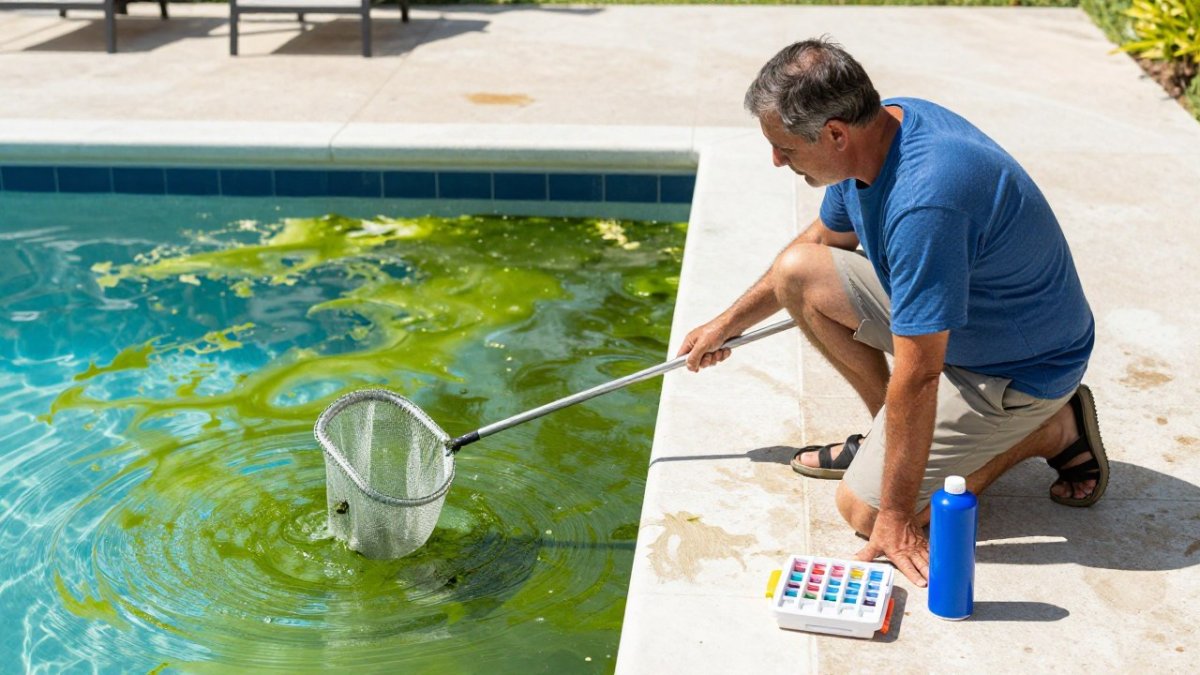
After any adjustment, run the pump for at least one full turnover, typically several hours for a residential pool, before retesting. Do not retest five minutes after adding acid and expect a final number. If a reading is only slightly outside range, a common pattern is to correct the larger deviation first and let the smaller one settle. If your chart shows cloudy water, treat chemistry before reaching for a clarifier. If the water has turned green, the cause is almost always sanitizer, not the filter.
How Often to Test Pool Water and When to Retest
How often to test pool water depends on load and season. A quiet residential pool needs chlorine and pH checked two to three times a week. A vacation rental with daily guests needs daily checks during the swimming season.
Retest after every chemical addition, once the pump has run at least one full turnover, typically several hours. Do not retest five minutes after adding acid and expect a final number.
Troubleshooting Inaccurate Readings and Handling Chemicals Safely
When a reading looks wrong, suspect the process before the pool. Most bad numbers come from stale reagents, a dirty vial, a sample taken at the surface, or a test read outside its time window. Confirm any surprising result with a second test before dosing.
Compare your testing methods by how they fail, not just how fast they are:
- Test strips are quick but fade with moisture and heat. Keep the container sealed, store it away from sunlight, and check the expiration date. A strip that has absorbed humidity can read low on chlorine and high on pH at the same time.
- Liquid drop kits are more precise but depend on exact drop counts and clean vials. Cross-contamination between reagents is a common cause of readings that make no sense, so rinse the vial with fresh water between tests.
- Digital meters are accurate for pH and salt but drift without calibration. Follow the manufacturer's calibration schedule and store the probe wet per its instructions.
If two methods disagree, trust the drop kit over the strip, and retest with a fresh sample before adding anything. A reading that changes wildly between two tests minutes apart usually points to the sample, not the pool.
Safety matters as much as accuracy. The EPA guidance on safe storage and handling of pool chemicals warns against mixing chemicals and against adding water to concentrated product. Always add chemicals to water, never the reverse. Store acids and chlorine separately, wear gloves and eye protection, and never combine two products hoping for a faster fix. Keep swimmers out until the pump has run a full turnover and a retest confirms the water is in range.
For a second opinion on a reading you did not take yourself, see how to verify professional pool water readings.
Request a Quote for Documented Weekly Water Testing
Getting chemistry right every week is a discipline, not a one-time task. If testing, dosing, and retesting keep slipping down your list, that is exactly the gap we close. Clear Water Pools provides weekly pool cleaning, equipment repair, and digital service reports with photos and water readings, so you can see the numbers behind every visit. The team is fully licensed and insured. Request a weekly pool cleaning quote to see how documented testing works for your property.
Verifying your own water is a skill worth having, but consistency is what keeps a pool safe all season. Clear Water Pools combines recurring weekly maintenance, documented digital reporting with photos and readings, and proactive equipment checks so nothing drifts between visits. Get started with Clear Water Pools and keep your water balanced, documented, and ready to swim.
Frequently Asked Questions
What is the best way to test pool water chemistry?
Drop-based liquid test kits give the most reliable pool water chemistry readings because you can watch the color change and stop at the exact endpoint. Test strips are faster but fade and can be thrown off by bright sunlight. Whichever you use, collect the sample at elbow depth, away from return jets, and test at the same time of day so you can compare results week to week.
How often should pool chemistry be checked?
Test free chlorine and pH two to three times a week during heavy swimming season, and total alkalinity once a week. Check calcium hardness and cyanuric acid monthly. After heavy rain, a large group swim, or a chemical adjustment, retest within 24 hours.
What should you do if pool test results are outside the recommended range?
Fix one reading at a time and start with total alkalinity, since it stabilizes pH. Adjust alkalinity, then pH, then sanitizer, retesting between each step. Never add two chemicals at once, and always add chemicals to water rather than water to chemicals. If results stay erratic after two adjustments, check your reagent dates and confirm your sample was collected correctly.
How do you test pool water with drops?
Fill the sample vial to the marked line, add the specified number of drops of reagent, cap it, and invert to mix. Count drops until the color stops changing, then match that count to the pool water testing chart for parts per million. Rinse the vial with pool water between tests, hold reagents vertically, and replace any reagent past its expiration date.