 How-to
How to Verify Professional Pool Water Readings
Last Updated: October 30, 2026
Quick Summary
To verify professional pool water readings, collect your own elbow-deep sample about 18 inches down, away from return jets and skimmers, and test it within a few minutes. Run the test twice on two fresh samples and compare the gap to your test's resolution. A small gap is normal measurement variation, but a large repeatable discrepancy warrants an on-site re-test.
- Sample elbow-deep about 18 inches down, away from return jets and skimmers.
- Test strips are fast and cheap for daily checks but less precise than liquid kits.
- Calibrate digital testers monthly and after hard knocks or big temperature swings.
- A large gap that repeats across two fresh samples from two locations is worth a conversation.
- Ask for an on-site re-test when a safety-critical number like free chlorine disagrees.
Table of Contents
- Why You Should Verify Professional Pool Water Readings
- Pool Water Sample Collection: Getting a Reading You Can Trust
- Pool Test Kit vs Professional Testing: What Each Method Can and Cannot Do
- Digital Pool Water Tester Accuracy and Calibration Checks
- Pool Water Test Results Explained: Reading pH, Free Chlorine, and Alkalinity
- How to Double-Check a Reading and Document a Dispute
- Requesting a Verified Water Reading From Clear Water Pools
- Frequently Asked Questions
Why You Should Verify Professional Pool Water Readings
A pool service report says your water is balanced. Can you prove it?
Digital service reports with photos and water readings are one way to keep records.
Here is the core problem. A reading is only as good as the sample, the test method, and the person running it.
Most pool owners never question a reading. That is the mistake.
Pool Water Sample Collection: Getting a Reading You Can Trust
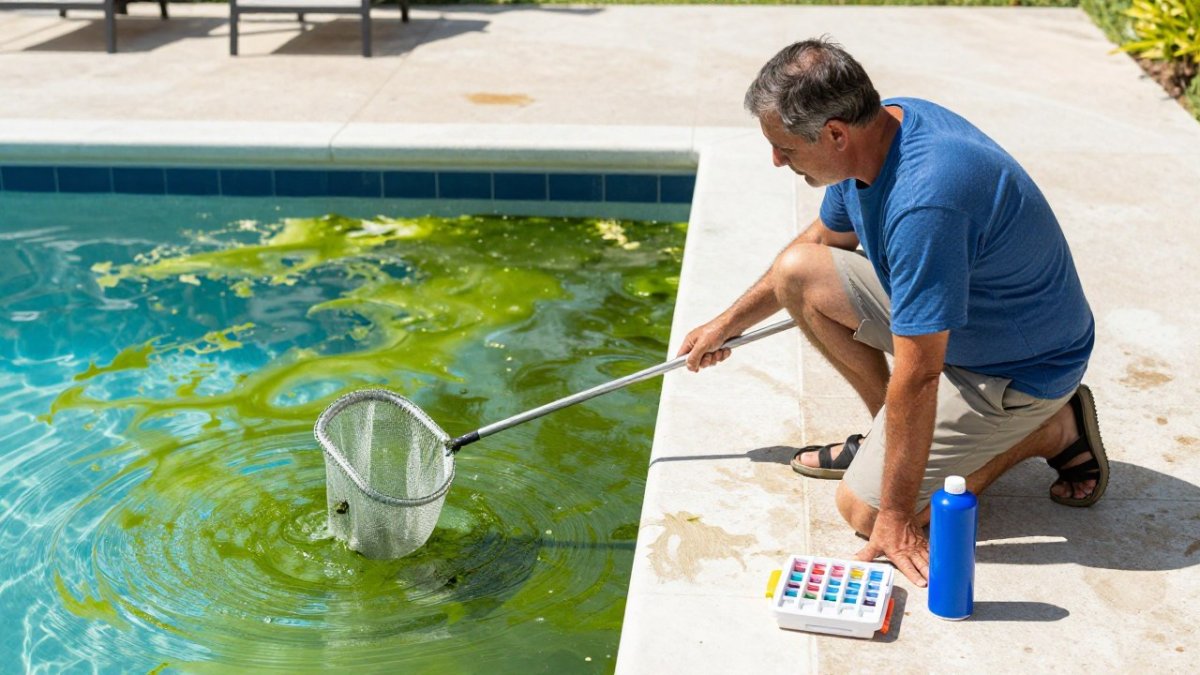
A trustworthy reading starts with a trustworthy sample. Grab water from the wrong spot and every number after that is suspect.
Deep water tells the truth. Surface water does not. Oils, pollen, and debris float on top, so a skimmed sample reads cleaner than the pool really is.
Follow these steps for a clean sample:
- Reach elbow-deep, about 18 inches down
- Hold the bottle mouth-down, then turn it upright underwater
- Fill it, cap it, and test within a few minutes
- Take samples from two spots, away from return jets and skimmers
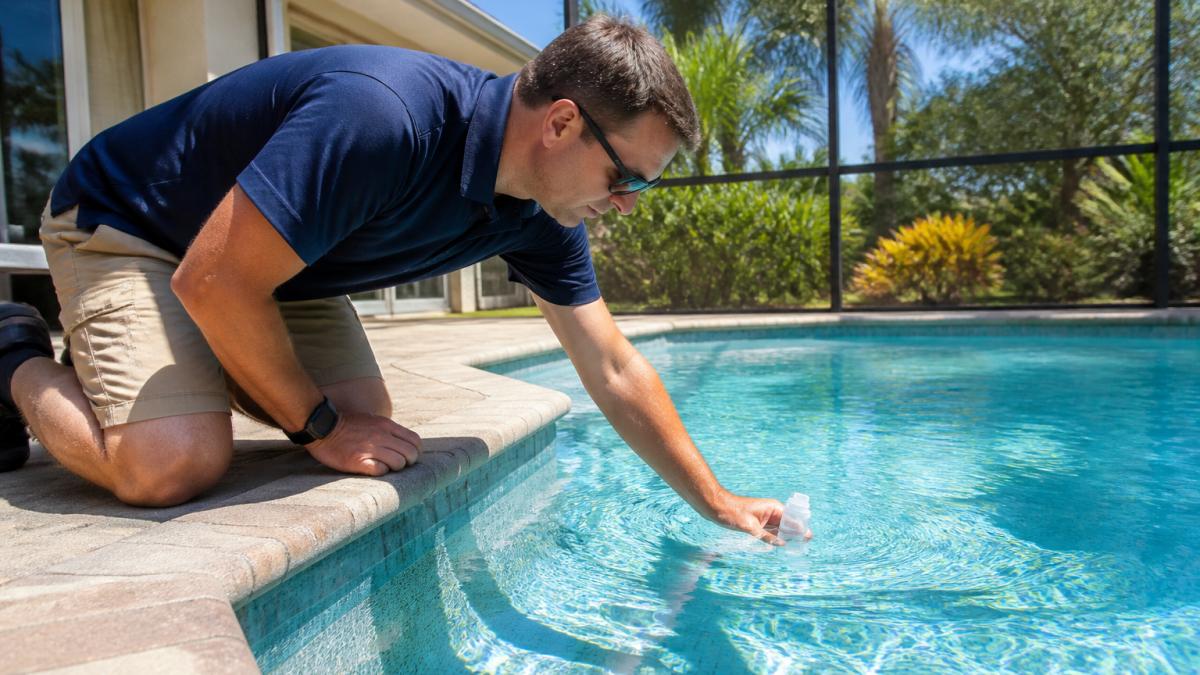
The Elbow-Deep Sample Method
The elbow-deep method is the simplest way to get a representative sample. Submerge your arm to the elbow, then fill the bottle at that depth.
Do not sample near a return jet. That water just left the filter and reads cleaner than the pool as a whole.
A common mistake is testing water that has sat in a bottle for an hour. Chlorine fades in a sealed container.
Pool Test Kit vs Professional Testing: What Each Method Can and Cannot Do
Neither a home test kit nor a professional visit is perfect. Each has limits you should know before you compare results. The goal is not to prove the pro wrong.
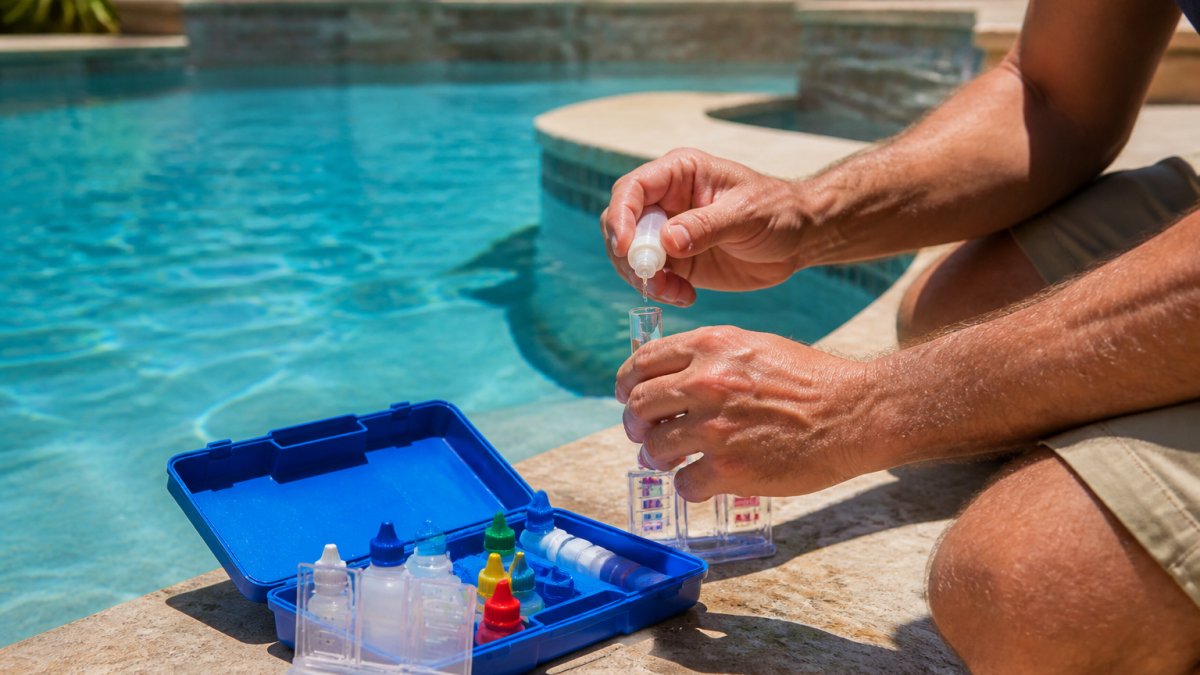
A pool test kit gives you a fast, cheap check you can run any day. Test strips are the quickest option. Liquid kits with drops are more precise. Both can drift if the strips get damp or the reagents sit too long in the heat.
Here is the honest split:
- Test strips: fast, cheap, good for daily checks, less precise
- Liquid kits: more accurate, slower, better for pH and chlorine
- Digital testers: precise when calibrated, need care and clean probes
Why Two Correct Tests Can Still Disagree
A mismatch between two readings does not always mean someone made a mistake. Every test method has a resolution (the smallest step it can display) and a precision (how tightly repeated tests cluster). A strip that reads in half-point pH steps cannot match a meter that reads to 0.01.
A few practical rules keep comparisons fair:
- Compare like with like. A strip result against a strip result is meaningful. A strip against a calibrated meter is a trend check, not a tiebreaker.
- Check expiration dates. Liquid reagents and strips degrade, especially in heat. An expired reagent can read confidently and be wrong.
- Test at the same time of day. Chlorine swings with sunlight and bather load, so a morning sample and an afternoon sample are not the same water.
A common pattern is a small, repeatable gap between a home strip and a professional meter. That is normal measurement variation. A large gap that repeats across two fresh samples from two locations is worth a conversation.
What Each Method Can and Cannot Verify
Use your kit to confirm the trend, not to settle a decimal-point disagreement. Strips and liquid kits are good at confirming that free chlorine is present, that pH is in the normal band, and that nothing has swung wildly since the last visit.
Professional meters and lab-grade methods are better at those less common parameters, but they still depend on calibration and handling. Our pool supplies without the heavy lifting page lists the gear and offers guidance on what fits your pool.
Digital Pool Water Tester Accuracy and Calibration Checks
Digital pool water tester accuracy depends on one habit: regular calibration. An uncalibrated meter can read confidently and still be wrong.
Most digital testers use a calibration solution with a known pH. You dip the probe, adjust the reading to match, and rinse.
Watch for these warning signs:
- Readings that jump between two tests minutes apart
- A pH that never moves, even after chemicals
- A probe with dried residue or a cloudy tip
If you want to run your own checks, you can pick up a tester, calibration supplies, and test chemicals locally.
Calibrating a Digital Tester at Home
Calibration takes about five minutes. Fresh calibration solution, a clean probe, and a steady hand are all you need.
- Rinse the probe with clean water and blot it dry
- Dip it in the calibration solution and wait for the reading to settle
- Adjust to the known value per the tester's instructions
- Rinse again and store the probe wet, as directed
Repeat the check monthly, and any time the tester takes a hard knock or a big temperature swing.
Pool Water Test Results Explained: Reading pH, Free Chlorine, and Alkalinity
Pool water test results explained in plain terms come down to a few key numbers. Know the target range for each, and a bad reading stands out fast.
Here is what to watch:
- pH: the acid-to-base balance. Aim for the mid-7s. Low pH stings eyes and eats equipment. High pH clouds water and weakens chlorine.
- Free chlorine: the active sanitizer that kills germs. This is the number that keeps water safe.
- Total chlorine: free chlorine plus used-up chlorine. If total runs well above free, you have combined chlorine, the source of that sharp pool smell.
A useful extra is the Langelier Saturation Index, or LSI. It combines pH, temperature, calcium, and alkalinity into one score. A score near zero means balanced water.
If a reading shows a problem, do not guess at the fix. If the water looks green, learn the causes and fixes for green pool water. For cloudy water, see how to clear cloudy pool water quickly.
How to Double-Check a Reading and Document a Dispute
A dispute is easy to win when you have a clean record. The trick is to build that record before you argue, not after. This is the part most pool owners skip, and it is the part that turns a vague complaint into a fixable issue.
Follow this sequence:
- Re-test with a fresh sample from a second spot
- Run the test twice and note both results
- Photograph your sample, your test, and the color chart side by side
- Save the service report next to your photos with the date and time
- Ask for a re-test on site if the gap is large
Separate Normal Variation From a Real Discrepancy
Measurement uncertainty is real. Two methods rarely match to the decimal. A small gap between your strip and a pro meter is normal. A large, repeatable gap is worth a conversation.
A practical way to judge it: compare the gap to the resolution of your own test. If your strip reads in 0.5 pH steps and the report differs by 0.2, that is inside the noise.
Watch for the patterns that point to a method problem rather than a water problem:
- Readings that jump between two tests minutes apart
- A pH that never moves, even after chemicals
- A probe with dried residue or a cloudy tip
When to Ask for a Repeat Test and When to Go to a Lab
Ask for an on-site re-test when the gap is large and repeatable, when the report and your sample disagree on a safety-critical number like free chlorine, or when the same discrepancy shows up on two consecutive visits. A re-test is cheap and fast, and most service providers will run one without argument.
An independent laboratory test is worth the cost when the disagreement persists after a re-test, when you suspect a parameter your kit cannot measure well (cyanuric acid, salt, phosphates, metals, combined chlorine), or when a dispute has become formal.
Build a Record That Resolves the Issue
When you raise it, keep it factual. Share your photos and the two readings. Ask what method and calibration were used. Most disagreements end there. If they do not, a simple log, date, time, sample location, test method, result, and a photo, is far more persuasive than a memory of a bad reading.
Here is the sequence to follow when you want to double-check a reading and build a record that resolves the issue.
| Step | What to do |
|---|---|
| 1 | Re-test with a fresh sample from a second spot |
| 2 | Run the test twice and note both results |
| 3 | Photograph sample, test, and color chart side by side |
| 4 | Save the service report next to your photos with date and time |
| 5 | Ask for a re-test on site if the gap is large |
Requesting a Verified Water Reading From Clear Water Pools
The best way to verify a reading is to work with a team that expects you to check. That is how we operate.
Our weekly service includes water balancing and documented maintenance, with digital reports that show photos and water readings.
Our team is fully licensed and insured, and we serve residential homeowners, property managers, and commercial facilities throughout Central Florida.
If you want a service plan built around clear, checkable records, request a Clear Water Pools service quote. You can also read what to expect from professional pool service before you decide.
Frequently Asked Questions
How accurate are digital pool water testers?
Digital pool water tester accuracy varies by model and upkeep. Most consumer units are accurate to within roughly 0.1 for pH and about 0.1 to 0.2 ppm for free chlorine when properly calibrated. Accuracy drops when the probe is dirty, the battery is low, or the tester has not been recalibrated with a buffer solution. Always rinse the probe with distilled water between tests, store it wet per the manufacturer's instructions, and recalibrate monthly. A digital tester is a useful cross-check against a service report, but treat any single reading as an estimate rather than a precise laboratory value.
What should I do if my pool test results differ from my service company's readings?
Repeat your test first to rule out a bad sample or expired reagent, then compare the two results against the recommended range for each parameter. Small gaps are normal because test methods differ. If pH or free chlorine differ by more than about 0.3 or 0.5 ppm, collect a fresh sample in a clean bottle and ask the company to re-test on the spot or share the raw reading from their digital report. Document both results with a timestamp and photo. A pattern of large, repeated gaps is worth a direct conversation about testing method and calibration.
How should a pool water sample be collected for a reliable reading?
Collect the sample from elbow-deep water, at least 18 inches below the surface, away from return jets, skimmers, and floaters. Use a clean bottle that has been rinsed with pool water, not tap water. Cap it, and test within 15 to 30 minutes because chlorine dissipates quickly in sunlight. For free chlorine, test immediately on site rather than carrying the sample indoors. Consistent sample collection is the single biggest factor in whether two readings can be compared fairly.
Which readings should a professional pool report include?
A complete service report should show free chlorine, combined chlorine, pH, total alkalinity, calcium hardness, cyanuric acid (stabilizer), and water temperature. Many reports also include total dissolved solids and a Langelier Saturation Index score to flag scaling or corrosion risk. Ask for the raw numbers, not just a pass or fail label. If a report only lists chlorine and pH, you are missing the measurements that explain why water balance drifts over time.
Your pool report should never be a black box. Test it yourself, compare the numbers, and keep a record. If you want readings you can trust and verify, get started with Clear Water Pools and put a documented, checkable service plan on your pool.