 How-to
How to Balance Pool Water Chemistry at Home
Last Updated: November 22, 2026
Quick Summary
To balance pool water chemistry, test a fresh sample first, then adjust in order: total alkalinity to 80-120 ppm, pH to 7.4-7.6, calcium hardness to 200-400 ppm, and sanitizer and stabilizer last. Add chemicals in half doses, circulate at least 30 minutes, and retest before the next addition.
- Test a fresh sample taken elbow-deep, away from return jets and skimmers, within an hour.
- Never add acid and chlorine at the same moment or in the same spot.
- For a rectangular pool, multiply length times width times average depth by 7.5 to get gallons.
- About 26 fluid ounces of 31.45% muriatic acid per 10,000 gallons lowers total alkalinity by 10 ppm.
- Cloudy water often means low chlorine or a filter that needs cleaning.
Table of Contents
- Start With a Proper Water Sample and Test Kit
- Pool Chemicals for Beginners: What Each One Does
- Ideal Ranges on a Pool Chemistry Cheat Sheet
- The Correct Order for Balancing Pool Water Chemistry
- How to Use a Pool Water Balance Calculator for Dosing
- How to Balance Pool Water Chemistry at Home: Step by Step
- Troubleshooting Cloudy Water, Scale, and Conflicting Readings
- Request a Clear Water Pools Water Balance Check
- Frequently Asked Questions
Start With a Proper Water Sample and Test Kit
Balancing pool water chemistry starts with one habit most owners skip: testing before you touch a single chemical. Testing before adjusting is the rule that keeps guessing out of pool care, because guessing is how pools turn cloudy and stay that way.
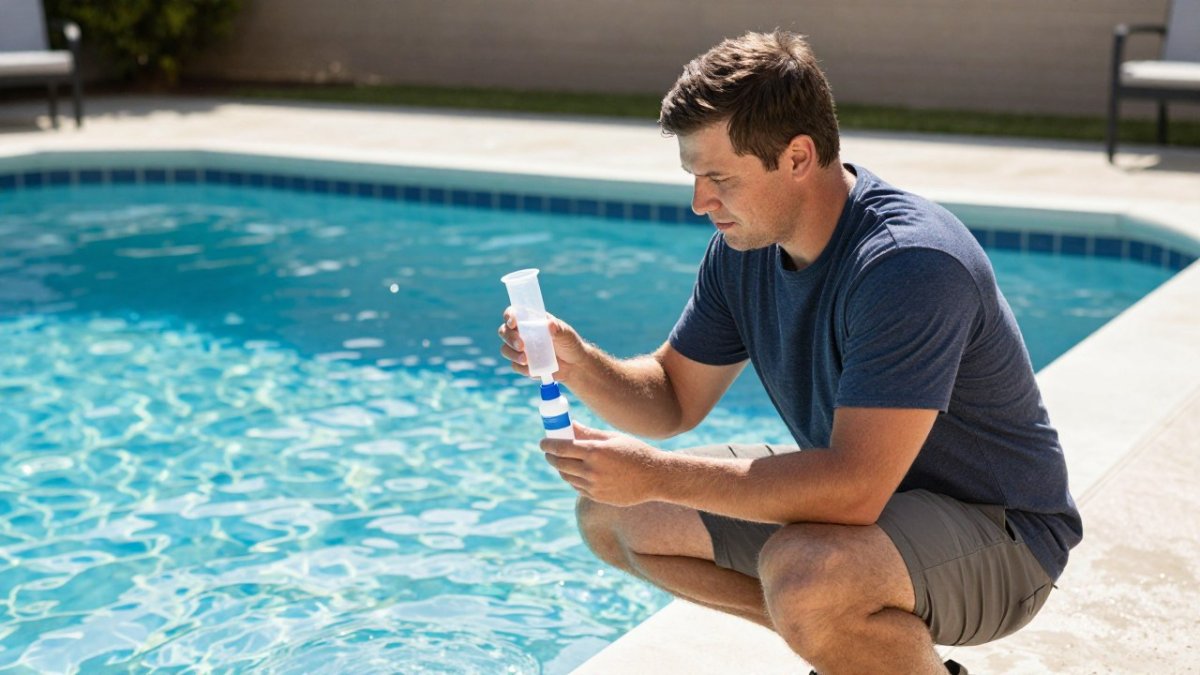
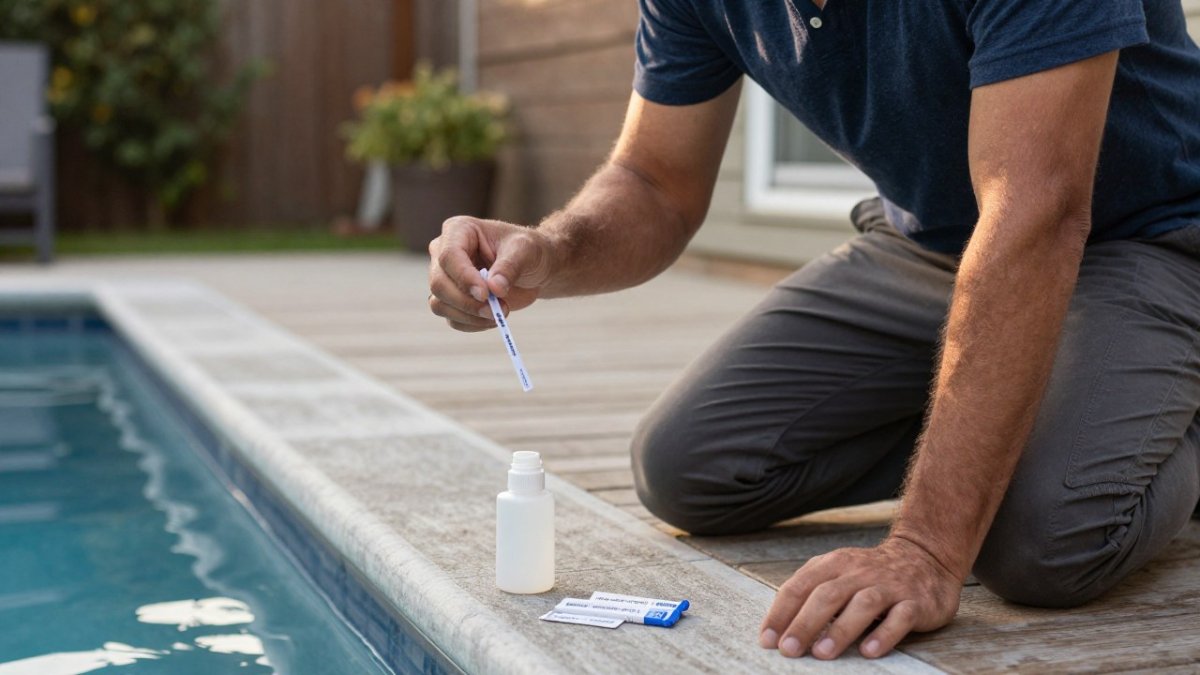
A good sample changes everything. Reach elbow-deep, away from return jets and skimmers, and fill a clean bottle. Test within an hour.
Pool water chemistry is the balance of pH, alkalinity, hardness, sanitizer and stabilizer that keeps water clear, safe and gentle on equipment.
Your kit matters too:
- Test strips for fast daily checks
- Liquid test kits for accurate pH and chlorine reads
- A digital meter if you want tighter numbers
Strips can fade and drift, while liquid kits generally hold up better. For a full walkthrough, see how to test your pool water step by step.
Pool Chemicals for Beginners: What Each One Does
Every pool chemical solves one problem, and mixing up their jobs is the fastest way to wreck your balance. Here is the short version.
- Chlorine sanitizes and kills bacteria
- Muriatic acid lowers pH and alkalinity
- Sodium bicarbonate raises alkalinity
- Calcium chloride raises hardness
- Cyanuric acid shields chlorine from sunlight
- Pool shock clears combined chlorine and organics
That is the whole shelf. Most beginners overbuy because nobody explained the jobs. Once you know what each one does, you can see current pool chemical options on our site.
Ideal Ranges on a Pool Chemistry Cheat Sheet
Here are the targets worth taping inside your pump cabinet. A pool chemistry cheat sheet only works if the numbers are right.
| Measure | Ideal Range | What It Affects |
|---|---|---|
| Free chlorine | 1-3 ppm | Sanitizing power |
| pH | 7.4-7.6 | Comfort and chlorine strength |
| Total alkalinity | 80-120 ppm | pH stability |
| Calcium hardness | 200-400 ppm | Scale and corrosion |
| Cyanuric acid | 30-50 ppm | Chlorine longevity |
Saltwater pools can run different stabilizer targets, so confirm with your system's guidance. Vinyl and plaster pools also tolerate hardness differently.
The Correct Order for Balancing Pool Water Chemistry
Order is where most DIY pools go wrong. Adjust in this sequence and each step stays put; skip around and you will chase the same reading all season.
- Total alkalinity first, because it locks pH in place
- pH second, once alkalinity is stable
- Calcium hardness third
- Sanitizer and stabilizer last
The reason for that sequence is mechanical, not ceremonial. Total alkalinity is the water's buffering capacity, the carbonate and bicarbonate that resist pH change (5.10 Total Alkalinity | Monitoring & Assessment). If you lower pH while alkalinity is still high, the buffer pulls pH right back up and your acid dose is wasted. If you raise pH while alkalinity is low, pH will swing wildly on the next addition. Stabilize the buffer first, and every later adjustment holds.
Hardness comes third because calcium and pH interact. Adding calcium chloride to water with a pH already out of range can push you toward scale or, in the other direction, leave the water aggressive. Get pH settled, then bring hardness into range so the two do not fight.
Sanitizer and stabilizer go last because chlorine's strength depends on pH. At a pH of 7.4 to 7.6, roughly half the free chlorine is in its active hypochlorous acid form; at a pH of 8.0, that active fraction drops sharply. Dosing chlorine into water with high pH is like paying for sanitizer you do not get to use. Cyanuric acid goes last as well, because it changes how much free chlorine your test reads and how much you need to add.
How to run each step without overshooting:
- Add the chemical, then run the pump for at least 30 minutes before retesting. For alkalinity and pH adjustments, most practitioners circulate for 1 to 2 hours and retest before the next addition.
- Add chemicals incrementally, roughly half the calculated dose, circulate, retest, then finish. Overshooting pH or alkalinity is far more work to correct than undershooting.
- Never add acid and chlorine at the same moment or in the same spot. Acid and chlorine react and neutralize each other, and concentrated contact can produce dangerous gas. Space them out by at least 30 minutes of circulation, and pour each into separate areas of the pool.
- Retest the full panel, not just the measure you changed, after the last addition settles, because one adjustment often shifts another.
Watch out: pouring acid and shock into the same spot within minutes can create a dangerous reaction. Add acid to water, never water to acid, and let the pump circulate between every addition.
A common pattern is a pool owner who lowers pH first, watches it climb back within a day, and concludes the acid is weak. The acid is fine; the alkalinity was never brought down first. The weekly pool maintenance checklist keeps this rotation on schedule so you never stack adjustments.
How to Use a Pool Water Balance Calculator for Dosing
A pool water balance calculator turns your test results into an actual dose instead of a guess. You enter pool volume and current readings, and it returns the amount to add. The gap most guides leave is the worked example, so here is one end to end. Once the dose is calculated, checking hardness alongside the other readings helps keep the balance grounded in the water itself, and Dooley’s Water fits naturally into that next step.
Step 1: Know your gallons. For a rectangular pool, length times width times average depth gives cubic feet; multiply by 7.5 to convert to gallons. A 30-foot by 15-foot pool with an average depth of 5 feet is 30 × 15 × 5 = 2,250 cubic feet, or about 16,875 gallons. Round to 17,000 gallons for dosing. For a round pool, use 3.14 times the radius squared times average depth times 7.5. For an irregular shape, break it into rectangles and circles and add them.
Step 2: Enter current and target readings. Suppose your test shows pH 7.9, total alkalinity 140 ppm, and calcium hardness 150 ppm in that 17,000-gallon pool. Your targets are pH 7.4 to 7.6, alkalinity 80 to 120 ppm, and hardness 200 to 400 ppm.
Step 3: Read the dose and add half. A calculator will return an amount in ounces or pounds. For alkalinity, the common rule of thumb is about 1.5 pounds of sodium bicarbonate per 10,000 gallons to raise alkalinity by 10 ppm. To bring 140 ppm down toward 120 ppm, you are lowering, not raising, so the tool will direct you to muriatic acid instead, roughly 26 fluid ounces of 31.45% muriatic acid per 10,000 gallons lowers total alkalinity by about 10 ppm, so a 17,000-gallon pool needs about 44 fluid ounces to drop 20 ppm.
Step 4: Repeat for each measure in order. Once alkalinity is in range, dose pH. Muriatic acid also lowers pH, so if you used it for alkalinity, retest pH before adding more. For calcium hardness, calcium chloride raises hardness roughly 1.25 pounds per 10,000 gallons per 10 ppm; to move 150 ppm to 250 ppm in 17,000 gallons, that is about 21 pounds, added in two halves with circulation between.
Step 5: Log the dose and the result. Write down what you added and what the retest showed. After two or three cycles you will know your pool's actual response rate, which is more reliable than any generic calculator because it accounts for your water, your volume estimate, and your test kit's bias.
Dosing by feel is how pools overshoot. Half doses protect you, and the retest is what turns a calculator's estimate into a real number.
Watch out: pool volume estimates are the most common source of dosing error. A pool that is actually 20,000 gallons dosed as if it were 17,000 will undershoot every adjustment, and the owner will blame the chemical. Measure depth at the shallow end, the deep end, and the middle, and average them.
How to Balance Pool Water Chemistry at Home: Step by Step
Here is a routine you can run at home.
- Collect a fresh sample and test all five measures
- Adjust total alkalinity toward 80-120 ppm
- Retest, then correct pH toward 7.4-7.6
- Bring calcium hardness into range
- Add sanitizer and check stabilizer
- Run the pump and retest after a few hours
Add chemicals to water, never water to chemicals. Wear gloves and eye protection, and never mix acid with chlorine in the same container. Store them apart.
Watch out: pouring acid and shock into the same spot within minutes can create a dangerous reaction. Space them out and let the pump circulate between additions.
Troubleshooting Cloudy Water, Scale, and Conflicting Readings
Cloudy water, white scale lines and readings that refuse to settle usually share one cause: something upstream is off.
- Cloudy water often means low chlorine or a filter that needs cleaning
- Scale points to high pH or hardness
- Corrosion hints at low pH or low alkalinity
- Readings that jump usually mean you tested too soon after dosing
Retest after circulation, not immediately. If numbers still fight each other, your test kit may be the problem. A focused guide on clearing cloudy pool water goes deeper than this section can.
Request a Clear Water Pools Water Balance Check
If balancing keeps slipping, hand it to a team that tests, doses and documents every visit. Clear Water Pools provides weekly pool cleaning and equipment repair, with digital service reports that include photos and water readings. Our crews are fully licensed and insured.
You get consistent visits, clear documentation and a pool that stays guest-ready. Get started with Clear Water Pools and request a weekly service quote for your pool.
Balancing water yourself is doable, but consistency is what keeps a pool clear all season. Clear Water Pools handles weekly cleaning, water balancing and equipment repair, with digital reports that show every reading and photo. Get started with Clear Water Pools and keep your water balanced without the guesswork.
Frequently Asked Questions
Should you balance alkalinity or pH first?
Adjust total alkalinity first, then pH. Alkalinity acts as a buffer that holds pH steady, so raising or lowering it afterward will drag pH off target again. Get total alkalinity into the 80-120 ppm range, let the water circulate for several hours, then retest pH and adjust it into the 7.4-7.6 range. Only after both are stable should you move on to calcium hardness and sanitizer levels.
How long should you wait to retest pool water after adding chemicals?
Wait at least four to six hours of full circulation before retesting, and longer after big adjustments. Muriatic acid and sodium bicarbonate need time to mix evenly, so a reading taken too soon shows a false result. Add one chemical at a time, let the pump run, then retest before dosing again. For chlorine and pH, a same-day retest after several hours of circulation is usually reliable.
What should you test first when balancing pool water?
Test total alkalinity first, then pH, then calcium hardness, and finally free available chlorine. Alkalinity controls how pH behaves, so testing it first prevents you from chasing a pH reading that keeps drifting. Cyanuric acid matters too, especially in saltwater pools, because high stabilizer levels lock up chlorine. Record every reading so your pool chemistry cheat sheet reflects the actual order you followed.
Does baking soda raise cyanuric acid?
No. Baking soda is sodium bicarbonate and raises total alkalinity, not cyanuric acid. Cyanuric acid, also called stabilizer, comes from a separate product and shields free chlorine from sunlight. Adding baking soda to fix a low stabilizer reading will only push alkalinity too high and can cause cloudy water or scale. Test cyanuric acid on its own and use a dedicated stabilizer product when the level is genuinely low.