 How-to
What Does Commercial Pool Maintenance for HOA Communities Involve?
Last Updated: November 5, 2026
Quick Summary
Commercial pool maintenance for HOA communities is the scheduled care of a shared community pool, including cleaning, water testing, chemical balancing, equipment checks, and recordkeeping that satisfies local health rules. It combines daily on-site checks, weekly professional visits, and seasonal deep work, with frequency set by bather load and surface area.
- Small, low-use community pools typically get one professional visit per week plus daily staff checks.
- Large pools with a spa, slide, or fountain may need three or more visits per week in summer.
- A complete weekly visit includes full water testing, brushing, vacuuming, filter and pump inspection, and a written report with photos.
- Opening and closing the pool for the season are separate line items, not part of a weekly visit.
- Boards should ask providers to identify the specific local rule that sets minimum inspection or testing frequency.
Table of Contents
- What Commercial Pool Maintenance for HOA Communities Actually Covers
- The HOA Pool Maintenance Schedule: Daily, Weekly, and Seasonal Tasks
- Your HOA Pool Maintenance Checklist for Board Oversight
- Commercial Pool Maintenance for HOA Communities Cost: What Drives the Budget
- What a Commercial Pool Maintenance Contract Should Include
- Health-Code Compliance, Records, and Board Reporting
- Emergency Response and Peak-Season Readiness
- Request a Quote for Your Community Pool
- Frequently Asked Questions
What Commercial Pool Maintenance for HOA Communities Actually Covers
A board-run pool is a different animal from a backyard pool. Dozens or hundreds of residents use it. Guests expect it to be open.
Here is the part most boards underestimate: the maintenance contract protects the board as much as the water.
If you want to see the full scope of what a professional program covers, review our commercial pool service built around your operation.
The HOA Pool Maintenance Schedule: Daily, Weekly, and Seasonal Tasks
A community pool needs three layers of care: daily checks by on-site staff, weekly professional service, and seasonal deep work. Skipping any layer shows up fast in water clarity and resident complaints.
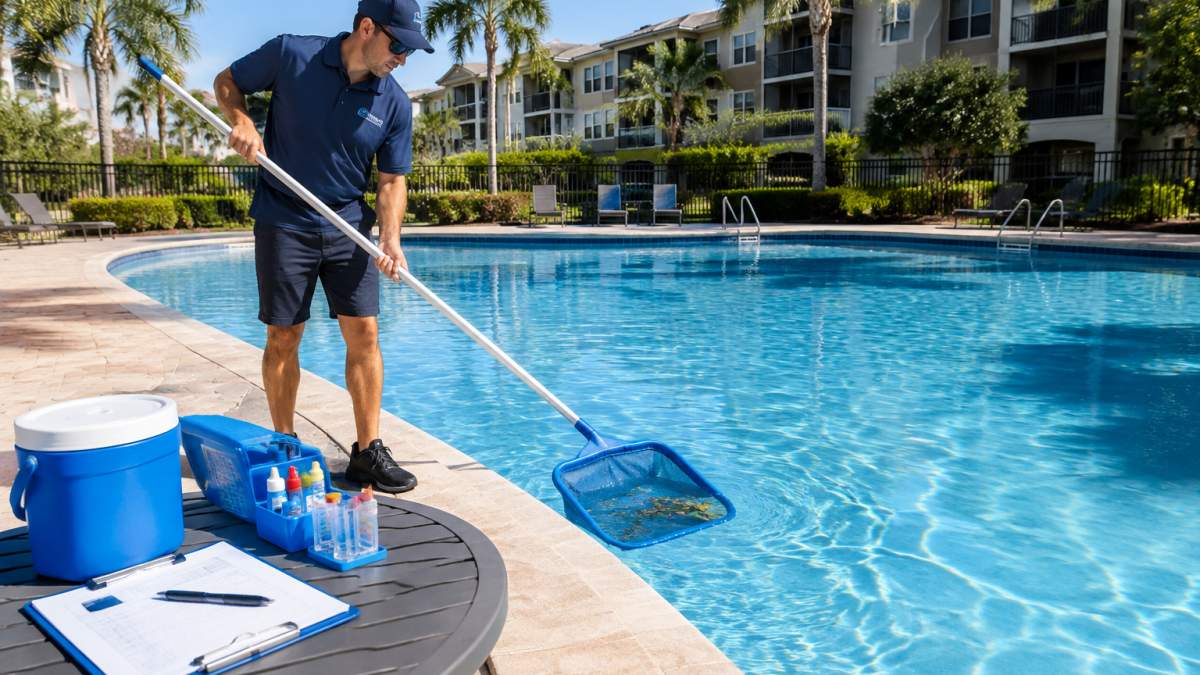
Daily tasks usually fall to on-site staff or a designated board volunteer:
- Skim the surface and empty skimmer baskets
- Check sanitizer and pH readings with a test kit
- Confirm gates, locks, and safety equipment are in place
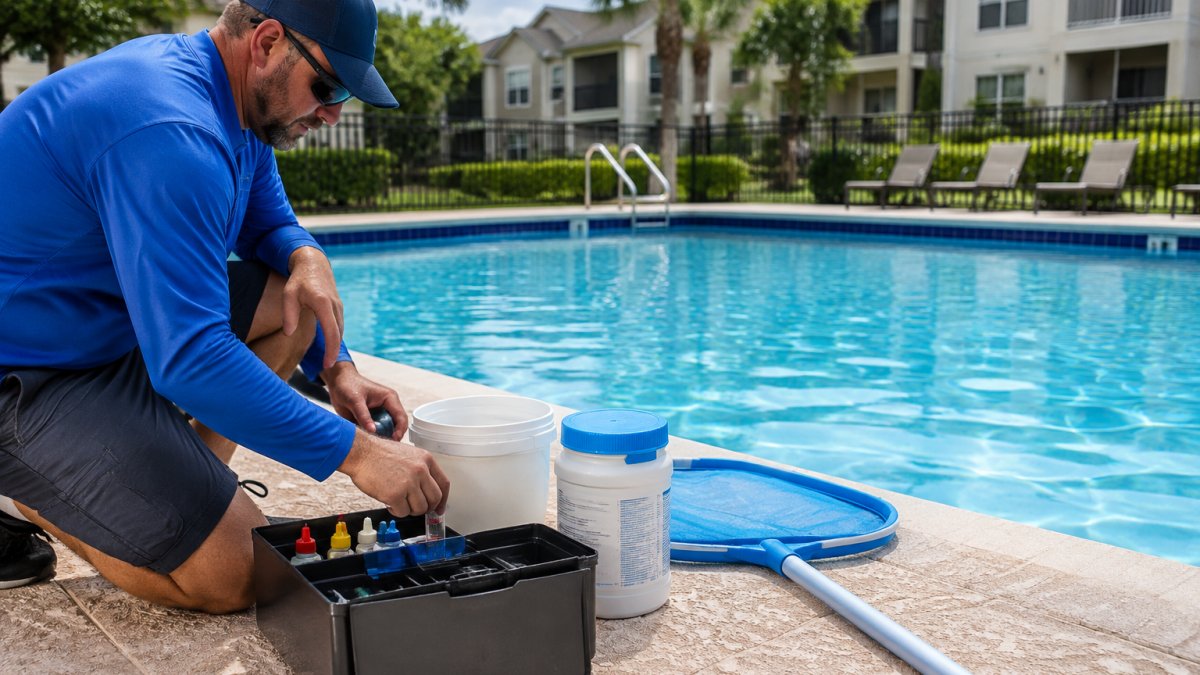
Weekly professional visits cover the technical work:
- Full water testing and chemical balancing
- Brushing walls, steps, and tile lines
- Vacuuming the floor
Seasonal work protects the pool through heavy-use stretches. Peak summer months call for extra visits. Cooler months are the window for equipment repairs, filter deep cleans, and surface touch-ups.
Many boards find that a fixed weekly schedule, with extra visits during peak season, keeps the pool guest-ready without guesswork.
How Frequency Changes With Pool Type and Use
A 1,200-square-foot plunge pool used by a 40-unit building and a 4,000-square-foot pool with a spa and splash pad used by 300 residents do not need the same visit count. Most practitioners set baseline frequency by bather load and surface area, then add visits for features that consume sanitizer faster. A common pattern:
- Small community pool, low use: one professional visit per week, with daily staff checks.
- Mid-size pool, year-round use: two visits per week during peak season, one in shoulder months.
- Large pool with spa, slide, or fountain: three or more visits per week in summer, because features recirculate water and drive up chemical demand.
High-use periods, holiday weekends, summer camps, swim lessons, and resident events, are when chemistry swings fastest. Boards should confirm in advance whether the contract includes extra visits around known events or charges them as add-ons.
Opening and Closing the Pool for the Season
In climates with a true off-season, opening and closing are separate line items, not part of a weekly visit. A proper opening includes removing the cover, cleaning and inspecting it, refilling to the operating level, restarting and priming equipment, shocking and balancing the water, and confirming safety equipment and signage before residents return. A proper closing includes balancing water for the dormant period, lowering the level per local frost depth, blowing and plugging lines where freezing is a risk, covering the pool, and documenting the equipment condition so spring repairs are not a surprise.
Why the Schedule Must Match Local Rules
There is no single national maintenance schedule. Requirements vary by state and often by county or city health department, and some jurisdictions set minimum inspection or testing frequencies that override a provider's default cadence. Before signing a contract, ask the provider to identify the specific rule that sets your minimum frequency, and verify it with your local health department.
A community pool runs on three layers of care, each with its own tasks and timing.
| Layer | Who handles it | Key tasks |
|---|---|---|
| Daily | On-site staff or board volunteer | Skim surface, empty baskets, test sanitizer and pH |
| Weekly | Professional service | Full water testing, brushing, vacuuming, filter and pump inspection |
| Seasonal | Provider | Extra peak-summer visits; cooler months for repairs and deep cleans |
Your HOA Pool Maintenance Checklist for Board Oversight
Boards do not need to clean the pool, but they should know what a complete visit looks like. Use this checklist to review service reports and hold any provider accountable.
- Water chemistry tested and logged with readings
- Surface skimmed, walls brushed, floor vacuumed
- Skimmer and pump baskets emptied
A common mistake is accepting a report that says "serviced" with no numbers. Ask for readings, not reassurances. This checklist is the fastest way to spot a provider cutting corners.
Commercial Pool Maintenance for HOA Communities Cost: What Drives the Budget
Commercial pool maintenance for HOA communities cost depends on pool size, visit frequency, equipment age, and how heavily residents use the water. Because resident use and equipment wear can also affect the surrounding deck, Pool Decks R Us connects routine pool upkeep with practices that help preserve deck surfaces.
The main cost drivers:
- Pool size and shape. Larger surface area and complex shapes take longer per visit.
- Visit frequency. Weekly is standard; peak-season extras add cost.
- Equipment condition. Older pumps and filters mean more repairs.
For real pricing context, see our breakdown of what weekly pool service costs in Florida. We quote each community after an on-site review, so the board sees exactly what drives its number.
What a Commercial Pool Maintenance Contract Should Include
A strong contract spells out scope, schedule, and accountability in plain language. If a term is vague, the board will argue about it later. Most competitors stop at a bullet list of terms; the sections below give the board a working scope-of-work template, bid-comparison criteria, and service-level metrics it can actually use.
Scope-of-Work Template
Every agreement should cover:
- Service frequency and what happens during peak season
- A written service checklist so the board knows what each visit includes
- Response time for emergencies and equipment failures
- Reporting format, including photos and water readings
- Repair approval process so no surprise charges appear
- Insurance and licensing verification
- Termination terms and notice periods
A scope of work that survives board turnover answers these questions in writing:
- What is included per visit: water testing and chemical balancing, surface skimming, wall brushing, floor vacuuming, basket emptying, filter pressure check, equipment visual inspection, safety equipment and signage check, and a written report with photos.
- What is excluded and billed separately: major repairs, equipment replacement, acid washing, tile and plaster work, leak detection, and after-hours callouts. Each exclusion should carry a rate or a rate schedule.
- Who supplies chemicals and parts: the provider or the association, and how costs are passed through.
Bid-Comparison Criteria
When the board solicits bids, compare them on the same grid rather than on the headline monthly price. Useful columns:
- Monthly base price and what it covers
- Included visit count and peak-season add-on price
- Emergency response time commitment and after-hours rate
- Reporting format and record retention
A common pattern is that the lowest bid wins on base price and loses on response time, reporting, or exclusions that generate change orders. The board should score bids against weighted criteria agreed before proposals arrive, not after.
Service-Level Metrics to Put in Writing
Service-level agreements work best when they name measurable commitments:
- Response time for urgent calls (for example, same business day) and for after-hours emergencies (for example, within a set number of hours).
- Visit completion rate and how missed visits are credited.
- Report delivery within a set time after each visit.
- Chemistry ranges the provider will maintain, and the corrective steps if readings fall outside them.
Watch out: a contract with no defined response time leaves your community waiting days after a pump fails on a holiday weekend. That is when residents notice most. Equally, a contract that promises a response time but names no after-hours contact is a promise the board cannot enforce.
Managing the Vendor After Signing
Oversight is a board habit, not a contract clause. A short monthly review of visits completed, readings in range, open repairs, and incidents keeps the relationship honest and gives the board a record if it ever needs to rebid. For property managers overseeing several communities, our one pool service partner for the properties you manage model keeps schedules and reporting consistent across every site.
Health-Code Compliance, Records, and Board Reporting
Health-code compliance means meeting your local and state pool rules for water chemistry, safety equipment, and recordkeeping. That includes routine inspections and logs that show the pool was maintained, not just cleaned.
Records are where weak providers fail. A compliant program keeps:
- Daily and weekly chemical readings
- Equipment maintenance history
- Inspection results and corrective actions
- Incident reports when something goes wrong
Board members should receive a short monthly summary: visits completed, readings in range, and any open repairs. For the specific rules that apply to your community pool, review our guide to commercial pool service requirements in Florida.
Emergency Response and Peak-Season Readiness
Emergencies happen: a pump dies, water turns cloudy before a holiday weekend, or a safety issue forces a closure. What matters is how fast your provider responds and how clearly they communicate.
Ask any provider three questions before signing:
- What is your response time for an urgent call?
- Who do we contact after hours?
- How do you handle a pool that must close for safety?
Peak-season readiness is planning, not luck. Before summer, the board should confirm the filter is clean, the pump is healthy, and the schedule includes extra visits. A pool that fails in July usually had warning signs in April.
Request a Quote for Your Community Pool
Every community pool has its own demands, and a generic quote rarely fits. We walk each property, review the equipment, and build a schedule that matches how residents actually use the water.
Clear Water Pools offers consistent weekly cleaning, digital service reports with photos and water readings, and responsive communication for property managers and homeowners. Before you request a quote, you can view our license documents to confirm we are fully licensed and insured.
Get started with Clear Water Pools and give your pool the consistent care it needs to stay clean, balanced, and ready.
Frequently Asked Questions
How much does commercial pool maintenance for HOA communities cost?
Pricing depends on pool size, bather load, service frequency, and the scope of the contract, so there is no single figure that fits every community. A small HOA pool with weekly visits costs less than a large high-use pool that needs twice-weekly service and daily chemical checks. Ask each provider for a written scope that lists visits, testing, cleaning tasks, and emergency response, then compare bids on that basis rather than on the monthly total alone. For current pricing, request a quote from Clear Water Pools.
What are the three C's of pool maintenance?
The three C's are cleaning, chemistry, and circulation. Cleaning covers skimming, brushing, and vacuuming the pool surface and walls. Chemistry means testing and balancing sanitizer, pH, alkalinity, and stabilizer so the water stays safe. Circulation means keeping the pump, filter, and flow working so water moves through the system and chemicals distribute evenly. A commercial pool maintenance contract should name all three, because skipping any one of them shows up as cloudy water, scale, or failed inspections within weeks.
How often does a commercial pool need to be cleaned?
Most community pools need skimming and debris removal daily during peak season, plus a full service visit at least once or twice a week depending on bather load. High-use pools near vacation rentals often need twice-weekly cleaning and more frequent chemical testing. Your local health department sets the minimum testing and recordkeeping requirements, so confirm those first, then set the schedule to match how many people actually use the pool. A written HOA pool maintenance schedule keeps the board and the vendor aligned.
What should an HOA look for in a commercial pool maintenance provider?
Look for a current license and insurance certificate, experience with pools of your size, a written scope of work, and a reporting system that documents each visit with photos and water readings. Ask how the provider handles emergencies, who answers after hours, and what response time they commit to in the contract. Check references from other HOAs or property managers. A provider that cannot show records from past clients will struggle to give your board audit-ready documentation.