 how-to
Commercial Pool Service Requirements in Florida
Table of Contents
- What Counts as a Commercial Pool in Florida
- Permits and Operating Approval for a Commercial Pool
- Pre-Opening Inspections and Health Code Compliance
- Florida Public Pool Water Testing Requirements
- Florida Pool Operator Certification and Staffing
- Your Florida Commercial Pool Maintenance Checklist
- Building a Commercial Pool Service Log Template
- Violations, Closures, and Reopening
- Frequently Asked Questions
Last Updated: October 21, 2026
What Counts as a Commercial Pool in Florida
If your pool serves the public, guests, or residents, it is a commercial pool, and Florida holds you to a stricter standard than a backyard owner. This guide from Clear Water Pools covers the commercial pool service requirements in Florida, from permits to daily logs, so you can stay open and inspection-ready.
The distinction comes down to who uses the water. A public swimming pool is any pool open to the public, whether admission is charged or not, hotel pools, apartment and HOA pools, and water park attractions.
A commercial pool is the broader business category: public pools plus pools at rental properties and other facilities operated for a business purpose.
Here is the practical split most operators miss:
- Private pool: one household, no public access, no operating permit
- Public pool: open to guests or residents, permit required
- Commercial pool: a business asset, subject to the full public pool rule set
That third category is where service requirements get real: a permit, a certified operator, documented water testing, and safety features that pass inspection.
Public vs. Commercial Pool Definitions
Three details decide which rules apply to your water:
- Who can swim there. Guests, residents, or paying customers make it public.
- How it is classified. Spas, wading pools, and interactive play areas each carry their own requirements.
- Whether it serves a business. Rental and hospitality pools fall under commercial operation.
A wading pool is not exempt just because it is shallow; it still needs proper circulation, disinfection, and drain safety.
Permits and Operating Approval for a Commercial Pool
You cannot open a commercial pool in Florida without an operating permit from the county health department.
The Florida Department of Health pool programs oversee public pool regulation across the state. Your county health department issues the permit, reviews plans, and conducts inspections.
Before applying, confirm your facility meets the construction and equipment standards in the state pool code. Retrofits, resurfacing, and equipment swaps often trigger a plan review before work starts.
The Permit Application Sequence
The permit process follows a predictable order. Skipping a step usually means a delay and a second fee.
- Confirm your pool classification with the county health department.
- Submit construction or modification plans if you are building or changing equipment.
- Complete the permit application with facility details and ownership information.
- Pay the required fees and schedule the inspection.
- Pass the pre-opening inspection before any bather enters the water.
- Post the operating permit where required and begin logging service.
A licensed pool contractor should handle structural and equipment work. A certified pool operator should be named for daily operations. Both roles matter at inspection time.
Pre-Opening Inspections and Health Code Compliance
A pre-opening inspection verifies your pool meets health and safety criteria before public use, checking water quality, circulation, safety equipment, signage, and barriers against the state pool code.
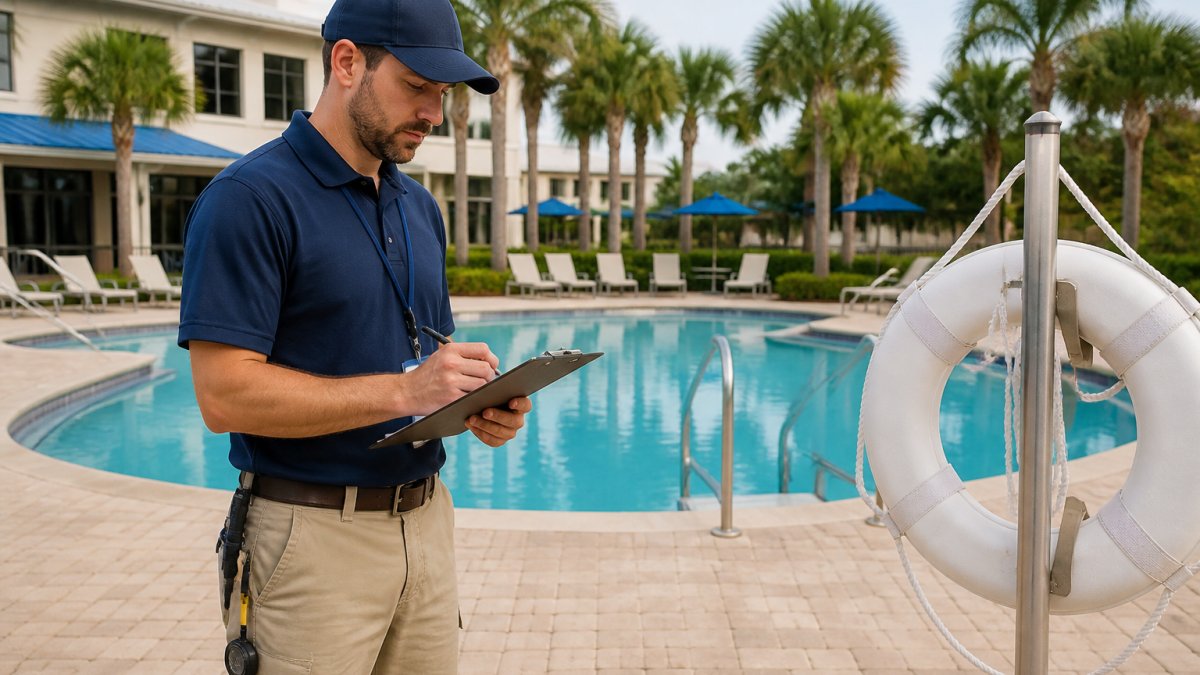
Expect a close look at these items:
- Filtration and circulation system operation
- Disinfection and chemical feed equipment
- Anti-entrapment drain covers and suction outlet compliance
The Americans with Disabilities Act requirements apply to public accommodations, and that includes accessible entry into the water.
Failures at this stage are usually small: a missing sign, a loose gate, or a drain cover past its service life. Fix them before the inspection, not after.
Florida Public Pool Water Testing Requirements
Water testing is the backbone of public pool compliance, and inspectors scrutinize it hardest because the log is the only proof that safe water was maintained between visits. The state pool code sets numeric limits for disinfectant and pH, enforced by your county health department. Pull the current figures from the code your county cites and post them at the equipment pad so every tester works against the same numbers.
The commonly enforced ranges most operators build their program around are:
- Free chlorine: a minimum residual that must be maintained at all times, with a higher target when cyanuric acid is present
- pH: a narrow band (typically 7.2 to 7.8) that keeps chlorine effective and protects surfaces and equipment
- Total alkalinity: tested at a routine frequency to keep pH stable
How Often to Test
Frequency is where facilities get cited. A common pattern:
- Disinfectant and pH: at least twice daily, and more often during heavy bather load, hot weather, or events
- Total alkalinity and cyanuric acid: weekly, or after significant water replacement
- Full chemical panel: weekly, with results retained
Test at consistent times, opening and mid-day, for example, so the log shows a real pattern rather than a single backfilled reading.
What the Log Must Capture
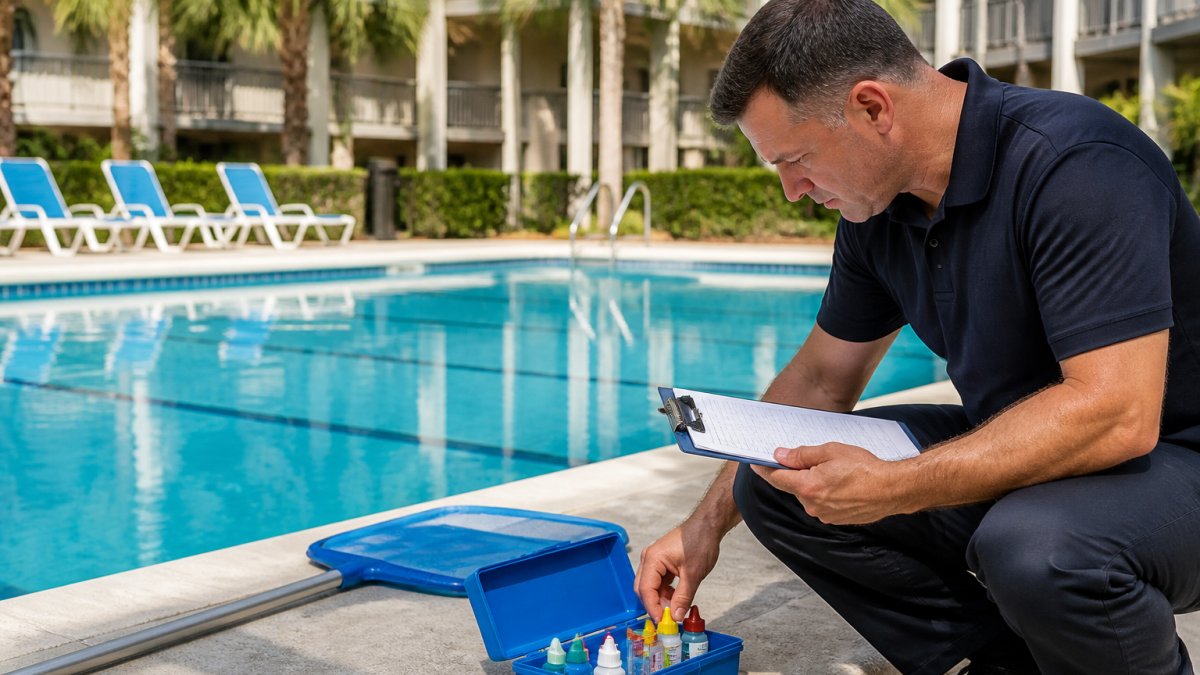
Every reading needs four things to survive an inspector's review: date and time, the numeric result with its unit, the tester's name, and the corrective action taken when a result fell outside range.
A defensible corrective-action entry looks like this: "2:15 p.m., free chlorine 0.8 ppm, below minimum; added 2 lb calcium hypochlorite, retested 3:00 p.m. at 2.4 ppm." That single line proves the operator tested, recognized the problem, fixed it, and verified the fix.
Inspection Readiness
When an inspector arrives, they review the last several weeks of logs, check that testing frequency matches bather load, and look for gaps, missing days, identical readings, or unverified corrective actions. Keep logs for the period your county requires, store them where staff can produce them within minutes, and make sure the person who tested can explain any entry. A log nobody can locate is the same as no log.
Florida Pool Operator Certification and Staffing
Every public pool needs a certified pool operator who is responsible for the facility's compliance, and that certification is not optional. The state approves specific operator courses, and the certificate must be current, an expired certificate is treated the same as no certificate at inspection time.
What Certification Actually Requires
The approved operator course covers water chemistry, circulation and filtration, disinfection, safety equipment, recordkeeping, and the regulatory framework. Passing earns a certificate renewed on the state's cycle, typically by retaking the course or completing continuing education before expiration. Confirm current renewal terms with the approving body, since the cycle and course list are updated periodically.
What the Certified Operator Is Responsible For
The certificate is not a decoration. The named operator is the person accountable for:
- Maintaining disinfectant and pH within the code ranges
- Keeping the required testing and corrective-action logs
- Ensuring safety equipment, drain covers, barriers, and signage are in place and functional
A technician who cleans and balances water still works under that certified operator's direction. The operator's name should appear in your records, and the certificate should be on file and easy to produce.
Staffing by Facility Type
Staffing scales with bather load and facility complexity:
- Single rental pool: one certified operator, with a technician handling weekly service and the operator reviewing logs
- HOA or apartment pool: a certified operator plus a documented service schedule and a backup contact
- Resort or water park: multiple trained staff, an operator available during open hours, and coverage for multiple pools and attractions
What most guides miss is the paper trail. Certification only helps if the certificate is current, the operator's name appears in your records, and the operator can explain the facility's testing and corrective-action history to an inspector. Build that file before the inspector asks.
Your Florida Commercial Pool Maintenance Checklist
A commercial pool maintenance checklist turns the rules into a repeatable routine. The CDC guidance on healthy swimming and pool operation reinforces the same basics: keep disinfectant in range, keep records, and fix problems fast.
Here is the checklist we would run at any commercial facility:
- Test disinfectant and pH and log the readings
- Check the circulation pump and confirm flow
- Inspect skimmers, baskets, and drain covers
Safety Features and Access Control
Barriers and access control prevent the worst outcomes. Florida pool rules require a perimeter barrier with a gate that self-closes and self-latches.
Anti-entrapment drain covers protect swimmers from suction outlet injuries. Replace them on the manufacturer's schedule, not when they look worn.
Access control also covers the small things: a propped gate, a broken latch, or a missing sign, the findings that turn a routine inspection into a violation.
Building a Commercial Pool Service Log Template
A service log proves your commercial pool service requirements in Florida are being met between inspections. Build one template and use it for every visit.
Your log should capture:
| Field | What to Record | Why It Matters |
|---|---|---|
| Date and time | Visit timestamp | Proves testing frequency |
| Technician | Name and certification | Shows qualified staffing |
| Free chlorine | Reading and unit | Confirms disinfection |
| pH | Reading | Confirms water balance |
| Corrective action | What you adjusted | Shows response to issues |
| Equipment notes | Pump, filter, heater status | Supports maintenance history |
| Signature | Technician initials | Adds accountability |
At Clear Water Pools, our digital service reports include photos and water readings for every visit. Property managers get a clear record of what was done, which is exactly what an inspector wants to see.
Keep logs for the period your county requires, and store them where staff can find them fast. A log nobody can locate is the same as no log.
Violations, Closures, and Reopening
A violation can close your pool immediately. Health departments can order a closure for unsafe water, a broken barrier, a missing drain cover, or an expired permit.
The response path is straightforward:
- Read the notice and identify every cited item.
- Correct the issue and document the fix with photos and readings.
- Request reinspection through the county health department.
- Reopen only after approval is granted.
Repeated violations cost more than the repair, triggering more frequent inspections and putting your operating permit at risk.
Budget for compliance too: set aside funds for drain cover replacement, lift servicing, signage, and certification renewals so a routine finding never becomes an emergency.
Running a commercial pool means proving, visit after visit, that the water is safe and the records are current. We provide weekly pool cleaning and equipment repair, digital service reports with photos and water readings, and responsive communication for property managers and homeowners.
Frequently Asked Questions
What are the requirements for operating a commercial pool in Florida?
A commercial pool in Florida needs an operating permit from the Florida Department of Health before it opens, and the facility must pass a pre-opening inspection. The pool also has to meet building and health code requirements for barriers, depth markings, safety signage, anti-entrapment drains, and accessible entry. Ongoing operation requires regular water testing, a certified pool operator or trained technician on staff, and maintained service records. Requirements vary by pool type and facility size, so check the specific rule chapter that applies to your pool.
How often must a commercial pool be tested in Florida?
Florida public pool water testing requirements call for testing disinfectant levels and pH at least twice a day, with additional checks during heavy use. Many operators test more often because bather load, heat, and rain can swing chemistry quickly. Record every reading with the time and the name of the person who tested. Consistent documentation is what inspectors look for, and it also gives you a clear picture of how your filtration and circulation systems are performing between service visits.
Does a commercial pool in Florida need a certified pool operator?
Yes. Florida pool operator certification is required for the person responsible for the day-to-day operation of a public pool. The certified pool operator oversees water quality, chemical handling, recordkeeping, and equipment checks, and their certification must stay current. Facilities often keep a backup trained technician so operations do not lapse when the primary operator is unavailable. Pairing certification with a documented maintenance checklist keeps the facility inspection-ready year-round.
What records must commercial pool operators keep?
Operators must keep daily water testing records, chemical addition logs, equipment maintenance notes, and inspection reports. A commercial pool service log template should capture the date, time, tester name, disinfectant and pH readings, chemicals added, and any equipment issues found. Keep records on site and organized by date so an inspector can review them without delay. Digital service reports with photos and water readings make this easier and give property managers a verifiable record of each visit.